Altcoin API Guide: How to Choose Crypto Market Data Sources
Compare crypto APIs by identifiers, exchange coverage, price methodology, historical revisions, rate limits, licensing, uptime, and data provenance.
Read article →Explore token categories, market-cap concepts, ranking dimensions, new-altcoin checks, and long-form research guides—without stale live prices or paid placement.
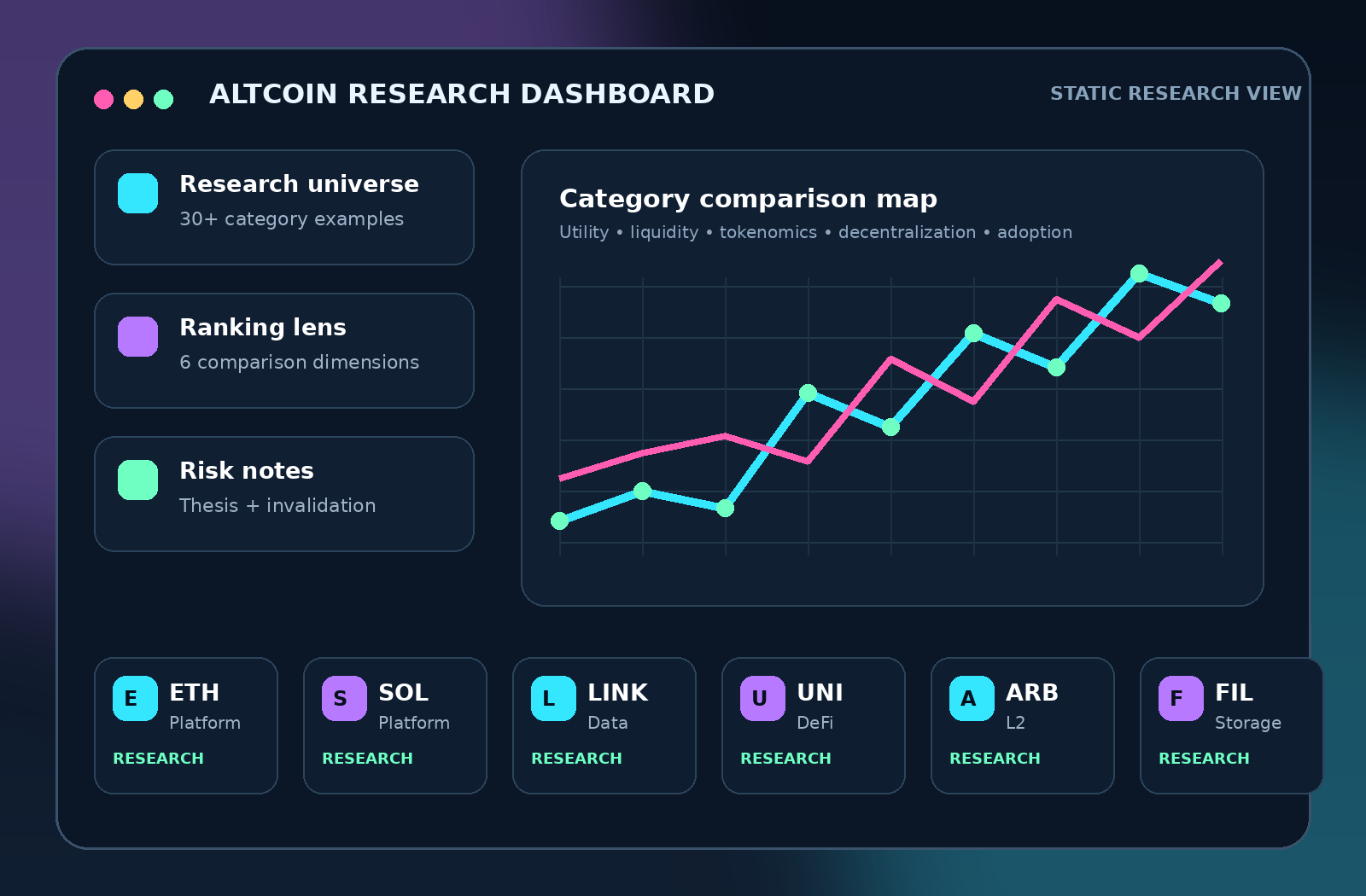
AltcoinList.com separates discovery, market structure, technology, tokenomics, and risk so one metric never pretends to answer everything.
Scan established examples by network role and open the research questions that matter for each category.
Open the list →Compare market size, liquidity, adoption, token economics, technical resilience, and governance without hiding the weights.
Review ranking dimensions →Verify identity, contracts, supply, ownership, liquidity, security, and operational dependencies before discussing valuation.
Use the checklist →This table is a category map, not a live ranking, recommendation, or complete market list. Verify current contracts and project status independently.
| Symbol | Project or network | Research category | Token or system role | Primary questions |
|---|---|---|---|---|
| EETH | Ethereum | Smart-contract platform | Fees, staking, application settlement | Scaling roadmap, client diversity, governance |
| SSOL | Solana | Smart-contract platform | Fees, staking, high-throughput applications | Validator economics, reliability, demand quality |
| AADA | Cardano | Smart-contract platform | Fees, staking, governance | Application adoption, governance execution |
| AAVAX | Avalanche | Smart-contract platform | Fees, staking, custom chain ecosystems | Subnet adoption, liquidity fragmentation |
| SSUI | Sui | Smart-contract platform | Fees, staking, object-centric applications | Adoption, emissions, validator distribution |
| AAPT | Aptos | Smart-contract platform | Fees, staking, Move-based applications | Usage retention, unlocks, ecosystem depth |
| LLINK | Chainlink | Oracle and data | Oracle services, staking, interoperability | Service demand, security economics, dependencies |
| PPYTH | Pyth Network | Oracle and data | Market-data delivery and governance | Publisher concentration, fee model, coverage |
| GGRT | The Graph | Indexing and data | Query markets, indexing, delegation | Query demand, reward sustainability |
| UUNI | Uniswap | DeFi exchange | Governance around exchange infrastructure | Fee rights, competition, governance participation |
| AAAVE | Aave | DeFi lending | Governance, safety and lending markets | Collateral risk, bad debt, governance control |
| CCRV | Curve | DeFi exchange | Liquidity incentives and governance | Incentive concentration, market structure |
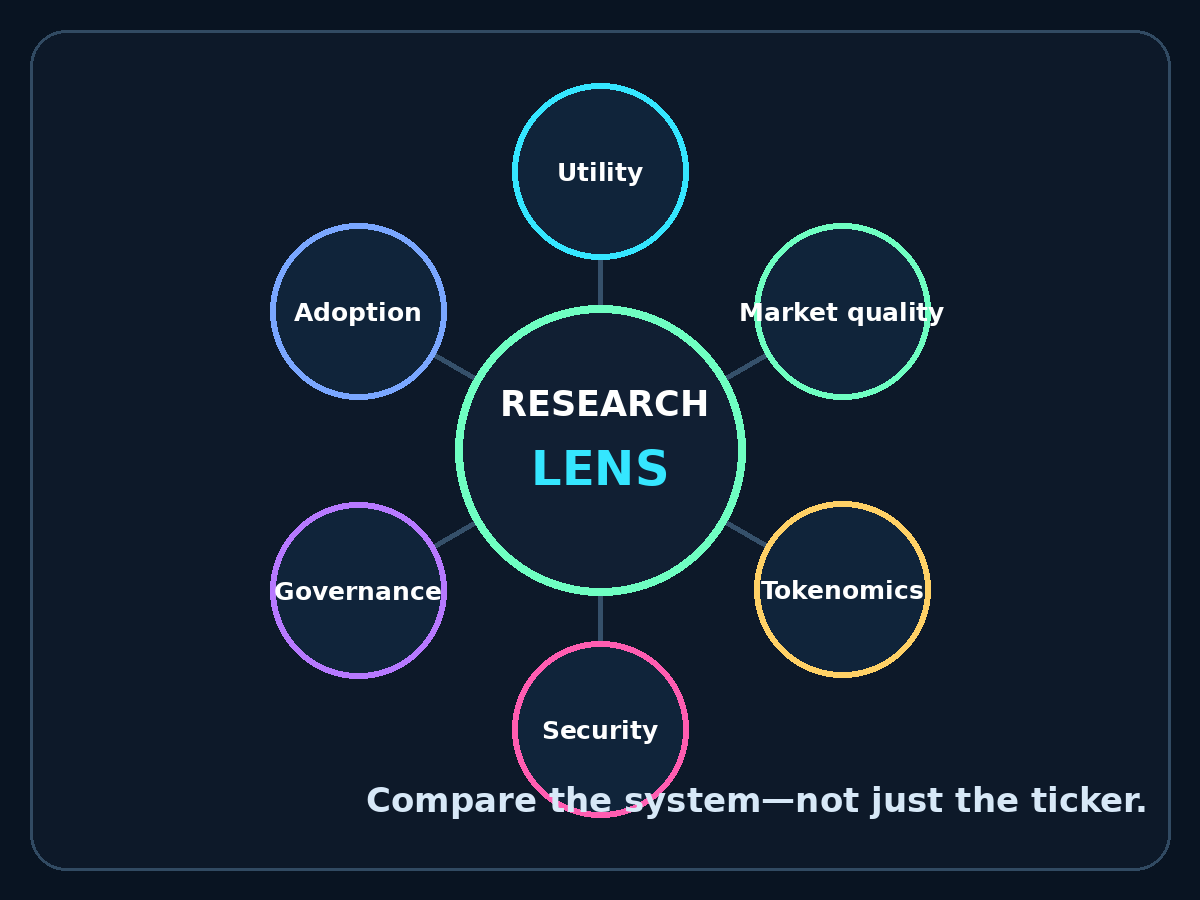
A useful altcoin profile connects product utility, market quality, tokenomics, security, governance, and adoption. Evidence stays visible instead of disappearing into one score.
Original, source-linked articles designed to support a repeatable research process.
Compare crypto APIs by identifiers, exchange coverage, price methodology, historical revisions, rate limits, licensing, uptime, and data provenance.
Read article →
Create a risk framework for volatile crypto assets using exposure limits, liquidity tests, custody maps, thesis reviews, and prewritten exit conditions.
Read article →
Read token supply like a capital structure by mapping minting, vesting, emissions, burns, ownership, governance, and market liquidity.
Read article →No. This static site focuses on durable research methods and does not label cached or manually entered values as live. The market-data and API guides explain how maintained products can source prices responsibly.
No. They are illustrative examples used to explain categories and research questions. Inclusion does not indicate quality, safety, expected return, or endorsement.
A useful ranking states the decision, metric definitions, data sources, time window, weights, and uncertainty. It keeps component evidence visible instead of relying on a mysterious overall score.
Begin with the research methodology, then build a small watchlist and use the new-altcoin checklist on one project. The goal is to practice verification before trying to cover the entire market.
Use the list, category map, ranking framework, and ten in-depth guides to record what you know, what remains uncertain, and what evidence comes next.