Crypto Rankings Built from Visible Dimensions
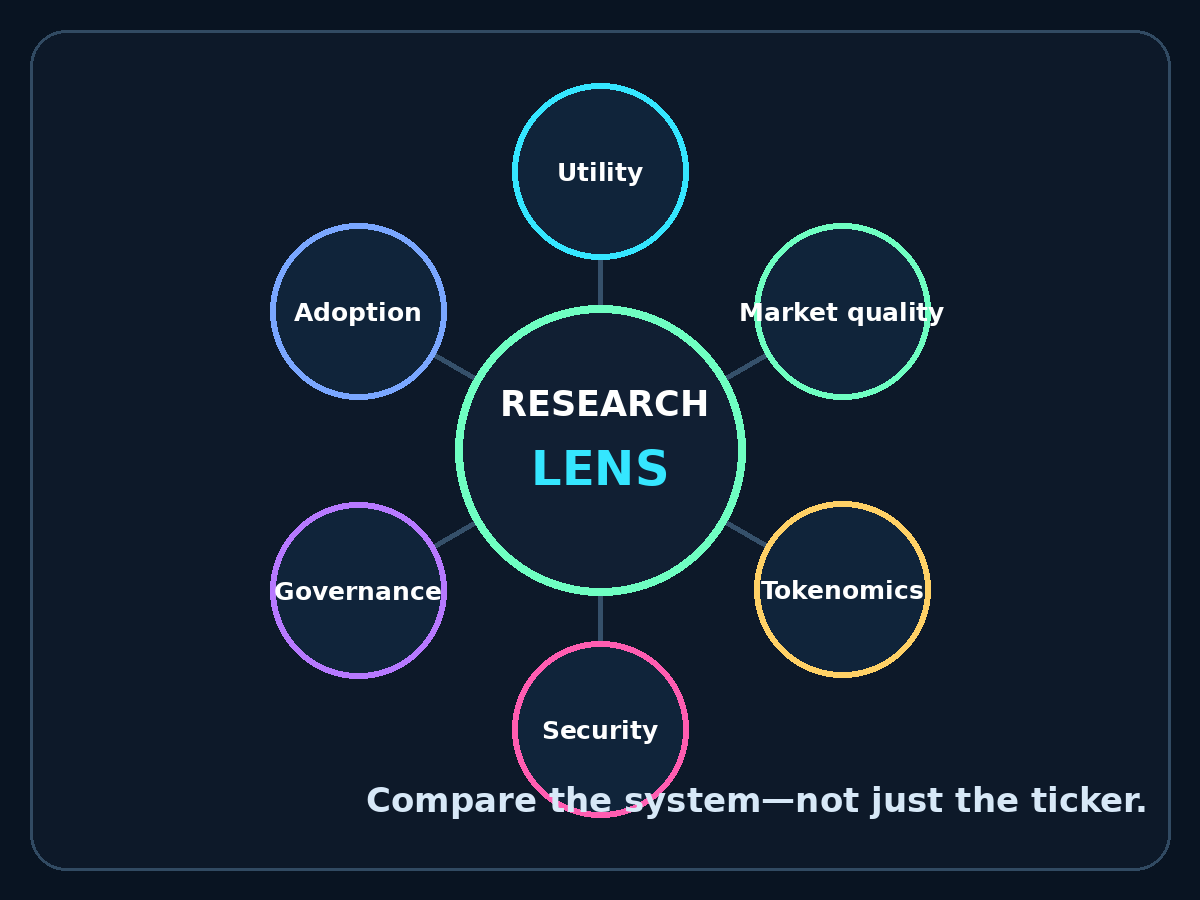
A ranking is useful only when its question, data, weights, and uncertainty are clear. This framework compares peers across six dimensions instead of publishing a context-free league table.
Rank the question, not the hype
Market capitalization answers a size question. Liquidity answers an execution question. Product usage, token rights, security, and governance answer different questions. Keep them separate before combining them.
Compare projects with similar functions and data windows.
Show how evidence maps to each band or score.
Check whether the order changes when priorities change.
A sample evidence scorecard
The percentages below are illustrative emphasis settings, not claims about any token. Adjust them to the decision and keep component notes visible.
Spreads, depth, pair diversity, venue concentration, volume quality.
Repeat usage, fee-paying demand, integrations, category-specific activity.
Utility, fees, supply, unlocks, emissions, ownership, value path.
Security design, audits, dependencies, client diversity, incident response.
Upgrade keys, voting concentration, time locks, emergency powers.
Primary-source support, recency, reproducibility, unresolved uncertainty.
From raw observations to an ordered comparison
State the decision
Examples: select projects for deeper research, compare market quality, or assess technical maturity. Different decisions need different weights.
Collect dated evidence
Use consistent time windows and definitions. Record source disagreements and missing data instead of forcing a number.
Assign bands before points
Use strong, mixed, weak, and insufficient evidence. Add numerical weights only when the precision is justified.
Run sensitivity checks
Change weights, remove one data source, and test adverse scenarios. A robust comparison should explain why the order changes.
Read the complete rankings guide
The long-form article explains market cap, liquidity, usage, token economics, risk, and transparent multi-factor ranking design.
Crypto rankings explained →